
It Might Sound Scary at First—But There’s a Good Reason Behind It
When many patients hear they’ll need IV antibiotics at home, one of the first questions they ask is:
“Does that mean a nurse is coming every day to give me my medication?”
The answer often surprises them.
In many cases, no.
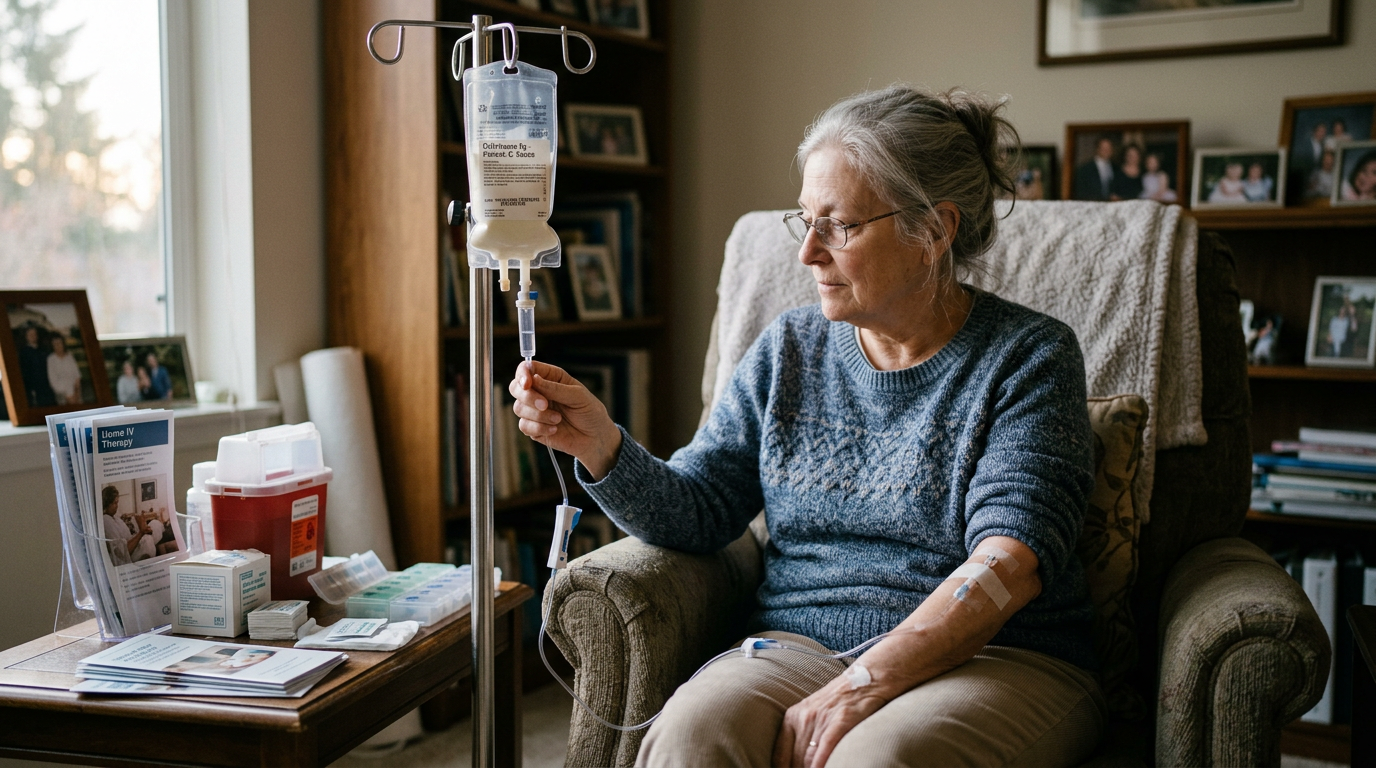
Instead, a home health nurse will teach the patient or a family caregiver how to safely administer the IV antibiotics themselves.
Here are some answers to questions to help ease the worry for patients:
- Why Doesn’t the Nurse Come Every Day?
- Home Health Is About Teaching Independence
- Patients Can Recover at Home
- Teach and Train
- Safety Comes First
- What If the Patient Can’t Do It?
- Does Learning to Do It Yourself Mean You’re On Your Own?
- Most People Are More Capable Than They Think
- The Bottom Line
At first, that idea can feel overwhelming. After all, giving medication through a PICC line or other IV catheter isn’t something most people ever imagined doing.
But here’s the good news: most patients and caregivers become comfortable with the process much faster than they expect.
Why Doesn’t the Nurse Come Every Day?
One of the biggest misconceptions about home health is that nurses provide around-the-clock care.
Home health nursing is designed to provide intermittent skilled care, not continuous bedside care.
The nurse’s job is to:
- Assess the patient’s condition
- Monitor for complications
- Perform sterile dressing changes
- Draw laboratory tests when ordered
- Communicate with the physician
- Teach patients and caregivers how to safely manage their care
Rather than performing every dose of medication, the nurse helps patients become confident enough to continue treatment safely between visits.
Home Health Is About Teaching Independence
One of the primary goals of home health is to help patients become as independent as possible.
Think of the home health nurse as a teacher and coach—not just someone who performs procedures.
Instead of saying,
“I’ll do this for you.”
The nurse says,
“Let me show you how to do this safely.”
That education gives patients more control over their care while still receiving professional support.
It Allows Patients to Recover at Home
Years ago, someone needing IV antibiotics for four to six weeks often had to remain hospitalized or travel daily to an infusion center.
Today, patients can recover where they’re usually most comfortable:
- In their own bed
- Around family
- With their normal routines
- Without a prolonged hospital stay
Learning to administer IV antibiotics at home makes this possible.
Nurses Don’t Just Teach Once
Teaching doesn’t happen in a single visit.
Home health nurses use a process commonly called teach-and-train.
During these visits, the nurse:
- Demonstrates each step
- Watches the patient or caregiver perform the procedure
- Corrects mistakes
- Reinforces infection prevention
- Answers questions
- Builds confidence
The goal isn’t speed—it’s safety.
If someone isn’t ready to administer the medication independently, the nurse continues teaching until they can do it correctly or helps coordinate an alternative plan.
Safety Comes First
Before a patient or caregiver administers IV antibiotics independently, they are taught how to:
- Wash their hands properly
- Create a clean work area
- Scrub the needleless connector (“scrub the hub”)
- Flush the catheter correctly
- Connect and disconnect the medication
- Recognize signs of infection
- Identify catheter problems
- Know when to call the nurse or physician
- Dispose of supplies safely
Every step is designed to reduce the risk of complications.
What If the Patient Can’t Do It?
Not every patient is able to administer IV medications independently.
For example, someone may have:
- Severe arthritis
- Poor vision
- Memory problems
- Dementia
- Tremors
- Physical limitations
- Anxiety about handling medical equipment
In these situations, a family member, caregiver, or another trained individual may learn the procedure instead.
If no safe caregiver is available, the healthcare team may consider other options, such as an outpatient infusion center or, in some cases, a short-term stay in a skilled nursing facility.
Does Learning to Do It Yourself Mean You’re On Your Own?
Absolutely not.
Even after a patient begins giving their own IV antibiotics, the home health nurse continues to provide skilled care throughout treatment.
The nurse will continue to:
- Perform weekly PICC or central line dressing changes
- Monitor the catheter site
- Draw laboratory tests when ordered
- Assess for medication side effects
- Reinforce education
- Communicate with the physician and infusion pharmacy
- Monitor the patient’s overall recovery
Patients are never expected to manage serious concerns by themselves.
Most People Are More Capable Than They Think
It’s completely normal to feel nervous the first time you connect IV tubing or flush a PICC line.
In fact, many caregivers say the same thing:
“I never thought I’d be able to do this.”
Yet after a few supervised visits, they often realize the process is much simpler than they expected.
By the end of the teach-and-train process, many caregivers are confidently administering medications that once seemed intimidating.
The Bottom Line
Teaching patients to give their own IV antibiotics isn’t about replacing the nurse. It’s about making sure they can safely continue their treatment between our visits. As home health nurses, we’re there to teach, answer questions, make sure everything is going well, and step in if there’s a problem.
Most patients and caregivers are nervous at first, which is completely normal. But with some “teach and train,” many realize they’re more than capable of doing it. Being able to receive IV antibiotics at home means less time in the hospital, more time with family, and the comfort of recovering in a place that feels familiar. That’s one of the things that makes home health such a valuable part of healthcare.