
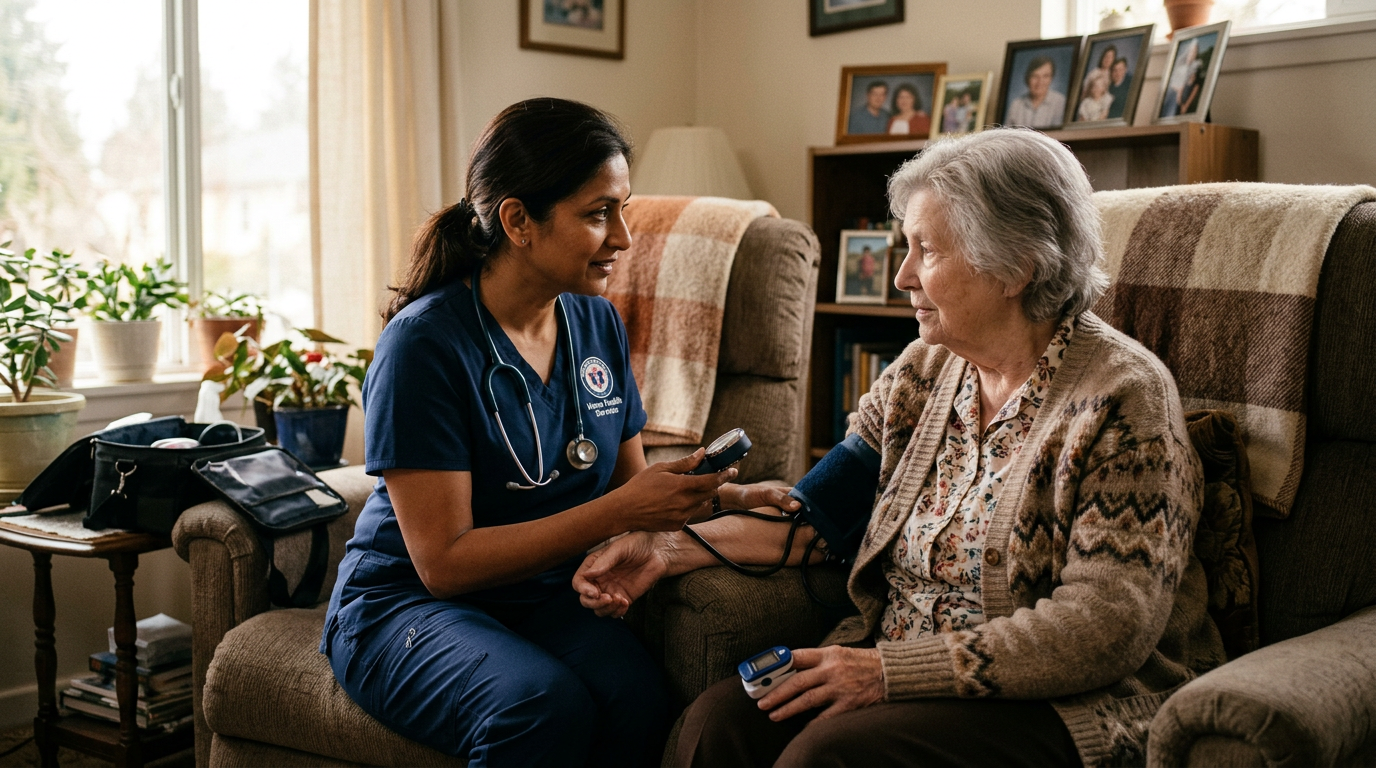
When many new home health nurses first hear the word OASIS, they assume it’s just another mountain of paperwork. In reality, OASIS is much more than a form—it’s a comprehensive assessment designed to paint a complete picture of the patient’s overall health and how well they can function safely at home.
Think of OASIS as a snapshot of the patient’s condition on the day you visit. It helps determine what skilled services the patient needs, establishes a baseline for measuring progress, and provides Medicare with standardized information used to monitor quality and reimbursement.
So, what exactly does OASIS assess?
- Medical Diagnoses and Comorbidities
- Vital Signs
- Mobility Status
- Can Patient Take Care of Themselves?
- Medication Management
- Pain
- Breathing
- Cardiac Health
- Memory and Cognition
- Elimination
- Wounds
- Fall Risk
- Caregiver Support
- The Big Picture
Medical Diagnoses and Comorbidities
One of the first things OASIS evaluates is the patient’s medical history.
This includes:
- Primary diagnosis
- Secondary diagnoses
- Chronic illnesses
- Recent hospitalizations
- Surgical procedures
- Other conditions that may affect recovery
For example, a patient admitted for a surgical wound may also have diabetes, congestive heart failure, chronic kidney disease, and peripheral vascular disease. Each of these conditions can affect healing, increase the risk of complications, and influence the overall plan of care.
Understanding the patient’s complete medical picture helps ensure the care plan addresses all of their healthcare needs—not just the reason for admission.
Vital Signs
Another important part of the OASIS assessment is checking your vital signs.
How is your blood pressure?
Is your heart rate regular?
Is your temperature normal?
What is your oxygen level?
How fast are you breathing?
As nurses, we don’t just write down the numbers.
We look at the whole picture.
Maybe your blood pressure drops when you stand up.
Maybe your oxygen level is normal while you’re sitting but drops when you walk.
Maybe your heart rate is much faster than usual.
Vital signs can tell us when something isn’t right, even before you start feeling sick. That’s why checking them is an important part of every home health visit.
How Well the Patient Moves
One of the biggest things the OASIS looks at is mobility.
Can the patient:
- Walk safely?
- Get out of bed?
- Stand up from a chair?
- Climb stairs?
- Use a walker or wheelchair correctly?
As nurses, we don’t just ask.
We watch.
I’ve had plenty of patients tell me they walk just fine. Then they stand up and immediately lose their balance or become short of breath.
That’s why observing the patient is so important.
Can They Take Care of Themselves?
Another big part of the OASIS is determining how independent the patient is.
Can they bathe themselves?
Can they dress?
Can they get on and off the toilet safely?
Can they prepare meals?
Can they feed themselves?
These are called Activities of Daily Living, or ADLs.
The answers help determine how much assistance the patient needs at home.
Medication Management
One thing I always tell new home health nurses is this:
Never assume the medication list is correct.
Hospital medication lists aren’t always up to date.
Patients stop medications.
Doctors change doses.
Some medications are sitting in the cabinet that nobody told the hospital about.
During the OASIS, we’re making sure the medication list is accurate and figuring out whether the patient understands what they’re taking.
Do they know why they’re taking it?
Can they take it correctly?
Does someone help them?
Medication errors are one of the biggest reasons patients end up back in the hospital.
Pain
Pain affects everything.
A patient may technically be able to walk, but if every step causes severe pain, they’re probably not walking very much.
That’s why the OASIS asks about:
- How much pain they’re having
- Where it hurts
- Whether the pain medicine is helping
- If the pain interferes with daily activities
Pain isn’t just about comfort. It affects recovery.
Breathing
For patients with COPD, CHF, pneumonia, or other lung conditions, breathing is a huge part of the assessment.
We’ll look at things like:
- Shortness of breath
- Oxygen use
- Activity tolerance
- Lung sounds
- Oxygen saturation
Some patients breathe fine sitting in a chair but become extremely short of breath after walking just a few feet.
That’s important information.
Your nurse assesses how well your heart is functioning by evaluating your heart rate, blood pressure, swelling (edema), circulation, symptoms of heart failure, chest pain, dizziness, and any cardiac conditions such as atrial fibrillation, hypertension, or coronary artery disease. This helps identify potential complications that may require ongoing monitoring.
Cardiac Health
The OASIS also looks at your heart and circulation.
How is your blood pressure?
Is your heart rate normal?
Do you have swelling in your legs or feet?
Have you been feeling short of breath, dizzy, or having chest pain?
The nurse will also ask if you have a history of heart problems like heart failure, atrial fibrillation, or high blood pressure. These answers help us decide if you need closer monitoring, medication education, or other skilled nursing services while you’re receiving home health care.
Memory and Cognition
The OASIS also looks at cognitive function.
Can the patient answer questions appropriately?
Are they oriented?
Do they remember to take medications?
Can they make safe decisions?
Patients with dementia or cognitive impairment often need much more caregiver support than someone with the same medical diagnosis but intact memory.
Elimination
The OASIS also looks at bladder and bowel function.
Are you having trouble controlling your bladder or bowels?
Are you dealing with constipation or diarrhea?
Are you able to empty your bladder completely?
Do you have a Foley catheter, suprapubic catheter, nephrostomy tube, or an ostomy?
These questions may feel a little personal, but they’re important. Problems with bladder or bowel function can increase the risk of infections, skin breakdown, and even falls. Knowing what’s going on helps us make sure you have the right care and supplies to stay safe at home.
Wounds and Skin
Your skin tells us a lot about your overall health.
If you have a wound, I’ll take a close look at it.
How big is it?
Is it getting better or worse?
Is there drainage?
Are there any signs of infection?
I’ll also check the rest of your skin, even if you don’t have a wound.
Are there any red areas?
Fragile skin?
Places that could turn into a pressure injury?
Catching skin problems early is much easier than treating them later, which is why checking your skin is an important part of every OASIS assessment.
Fall Risk
Falls are one of the biggest reasons our patients go back to the hospital.
During every Start of Care, I’m already looking around the house.
Are there loose rugs?
Poor lighting?
Cluttered walkways?
Do they have grab bars?
Are they using the walker correctly?
Sometimes the house tells me as much about the patient’s fall risk as the patient does.
Caregiver Support
Not every patient lives alone.
Some have a spouse who’s able to help with everything.
Others have a daughter who visits once a week.
Some have no one at all.
The OASIS looks at what kind of support system the patient has because it makes a big difference in what they can safely do at home.
The Big Picture
When you put all of these pieces together, the OASIS is really trying to answer one question:
What does this patient need to stay safely at home?
It’s looking beyond the diagnosis.
It’s looking at how the diagnosis affects the patient’s everyday life.
Can they move safely?
Can they take their medications?
Can they care for themselves?
Do they have someone to help them?
Are they likely to end up back in the hospital?
Those are the questions we’re really answering every time we complete an OASIS.
Final Thoughts
I know the OASIS can feel overwhelming, especially when you’re new to home health.
Trust me—I remember staring at all of those questions and wondering if I’d ever finish an OASIS in less than four hours.
The good news is that it gets easier.
As you complete more SOC visits, you’ll begin to recognize the questions and understand what the OASIS is really asking. You’ll also realize that you’re already gathering most of this information during your nursing assessment. The only difference is that now you’re documenting it in a standardized way.
With experience, you’ll become faster and more confident because you won’t have to stop and think about every question. You’ll know what to look for, what to ask, and how to document it efficiently.
The OASIS isn’t just paperwork—it’s a way to tell your patient’s story. It captures where they are today, what challenges they’re facing, and what skilled care they need to remain safe at home.
Once you start looking at it that way, it becomes much easier to understand—and a lot less intimidating.