
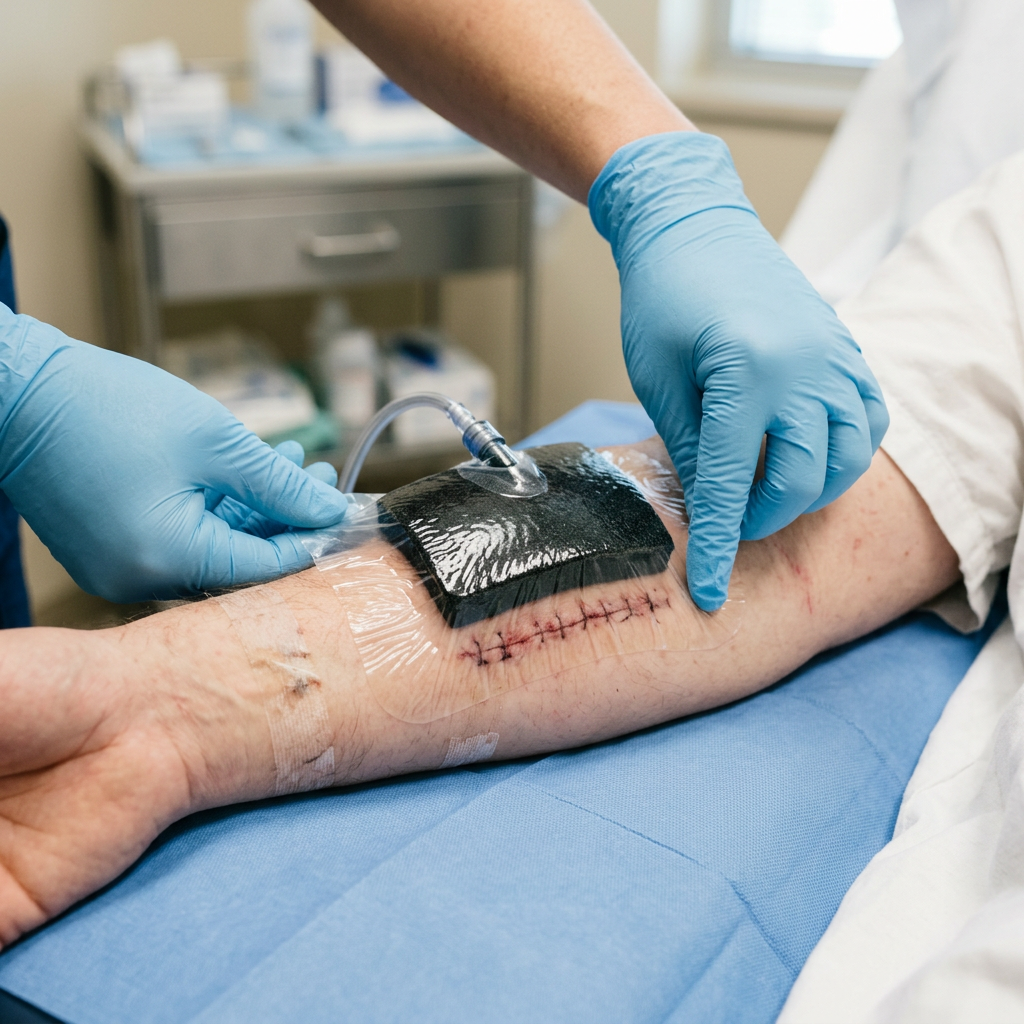
Everyone Thinks the Wound Is the Hard Part
If you’ve never worked with a wound vac before, you might assume the hardest part is looking at the wound itself.
Sometimes it is.
But for many home health nurses, the real challenge isn’t the wound at all.
It’s the transparent dressing.
I’ve lost count of how many times I’ve stood in a patient’s home carefully preparing a wound, applying the foam perfectly, only to spend the next thirty minutes fighting with the drape. You smooth it down. It wrinkles. You lift it. It sticks to itself. You try again. The machine starts running and immediately begins screaming about an air leak.
Then the real frustration begins.
The Battle Against Air Leaks
You press around the edges searching for the leak. You add another strip of drape. The leak moves somewhere else. You patch that area. The machine complains again. Before long you’ve used half the dressing kit and you’re questioning every life decision that brought you to that patient’s living room.
Every home health nurse has been there.
Some days, finding an air leak feels like trying to find a tiny hole in an inflatable pool while someone keeps adding more water. You know it’s there, but locating it can take far longer than expected.
What Exactly Is an Air Leak?
An air leak usually happens when outside air gets into the wound vac system. In other words, somewhere around the dressing there isn’t a good enough seal to keep the suction in.
A wound vac only works if it can keep constant suction on the wound. That suction helps pull out drainage, reduce swelling, and create an environment where healthy tissue can grow. But if air is leaking in, the machine can’t hold the pressure it’s supposed to.
And every home health nurse knows what comes next…
The machine starts beeping nonstop.
You find yourself chasing the leak with little pieces of transparent dressing, pressing down every edge, hoping you’ve finally found it. Sometimes you get lucky. Other times, after 20 minutes of patching one spot after another, you end up pulling the whole dressing off and starting over.
That’s why I always say:
A wound vac is only as good as its seal.
Why Healthy Skin Matters
One of the biggest lessons I’ve learned is that the drape needs to extend onto healthy skin whenever possible.
The adhesive dressing needs a clean, dry, stable surface to create an airtight seal. When portions of the drape sit on moist tissue, damaged skin, uneven wound edges, or areas with excessive drainage, air can easily sneak underneath.
This is why protecting the periwound skin is so important.
If the surrounding skin becomes irritated, macerated, or damaged, each future dressing change becomes more difficult. A poor skin surface often leads to more leaks, more patching, and more frustration.
Protecting Fragile Skin
Many home health patients are elderly and have extremely delicate skin.
I’ve cared for patients whose skin seemed to tear if you looked at it the wrong way. In those situations, removing and reapplying the drape multiple times can create even more skin damage.
That’s why I try to spend extra time preparing the skin before applying the dressing. Skin prep products, protective barriers, and careful placement can make a huge difference.
A few extra minutes at the beginning can sometimes save thirty minutes of troubleshooting later.
The Difficult Wounds Nobody Talks About
Not every wound is located in a convenient place.
Sacral wounds, hip wounds, wounds near skin folds, and wounds in areas with constant movement can be especially challenging. Patients sit, walk, bend, sleep, and reposition throughout the day.
Every movement creates another opportunity for the dressing to lift.
I’ve had wound vacs that looked absolutely perfect while the patient was lying still, only to start leaking the moment they rolled onto their side.
Those are the visits that test your patience.
When the Drape Has a Mind of Its Own
Sometimes the transparent dressing feels like it has its own personality.
It sticks to your gloves. It folds onto itself. It wrinkles at exactly the wrong moment. You carefully position it, only to discover a crease that creates a leak later.
Then comes the patchwork.
A small strip here.
Another strip there.
One more piece over the corner.
Before long, the dressing starts looking like a home improvement project instead of a medical device.
What Patients Never See
Most patients don’t realize how much work goes into getting a wound vac to function properly.
They see the machine, the tubing, and the dressing.
What they don’t see is the nurse standing there listening for tiny hissing sounds, smoothing wrinkles, cutting strips of drape, holding pressure over a stubborn corner, and praying the machine finally stops alarming before the visit ends.
The best wound vac dressing changes are often the ones that nobody notices.
Why It’s Worth the Effort
Despite all the frustrations, wound vac therapy can be one of the most effective tools we have for wound healing.
When everything works correctly, it helps remove excess drainage, supports healthy tissue growth, and can significantly improve healing outcomes.
But after years in home health, I’ve learned something that every wound care nurse eventually discovers:
The wound usually isn’t what tests your patience.
It’s the transparent dressing.